Tech revolution in social care
Social care is late in the game — let’s face it. Healthcare, particularly in private markets like the US, has been quick to invest and cash in on new technologies, leading the way in innovation. The NHS, although an excellent public healthcare system, has been slow to wake up to the digital innovation age but has been quickly catching up. Social care, on the other hand, although majorly privatised since the 1970’s (LaingBuisson research), has had little incentive to innovate.
Well, no more — given the current fiscal climate (austerity and such) that is driving down commissioning budgets and care worker pay, ageing population with increasing comorbidities, rapid disruption of established healthcare models, shortage of health and care workers, and movement of healthcare into homes, the social care sector has no choice but to reinvent itself.
Commissioning for social care is changing
Commissioning is the process of buying up care — essentially it is an annual cycle of assessing needs, planning services, procuring them and monitoring quality of these services through local Clinical Commissioning Groups (CCGs). The current system of commissioning is based on the Health and Social Care Act 2012 but has been changing since. The NHS Five Year Forward View (2014) and next steps have outlined strategies for better care commissioning, and two worth mentioning are The Better Care Fund and Accountable Care Organisations (ACOs). The Better Care Fund has had major setbacks with increasing costs and no evidence for improved outcome, while the ACO model holds promise still. Here is a brief summary of the history and future of accountable care organisations by The Brookings Institution (as proposed by ObamaCare in the US). A more in-depth report from the Kings Fund on how care commissioning is changing can be found here, and an interesting take on why this has failed so far is here.
Diminishing care worker pay is exacerbating the workforce crisis
The ‘task and time’ model — where care workers can be scheduled for as short as 15 minutes based on the task at hand is increasingly leading to lower pay, poor training opportunities, and zero-hour contracts. Some councils’ pay for residential care can be as low as £2.24 an hour. It is no surprise almost 50% of care workers leave within a year of starting, either switching industries or moving to private only providers with better rates. Approximately 50% of home care workers have zero-hour contracts (compared to 2.9% of the national workforce!), which means they don’t get paid for when there is no work available. Add on top of all this the fact that EU nationals are an increasing workforce in the social care industry and the looming impacts of Brexit, we’ve got ourselves a crisis.
People are living longer, sicker, and lonelier
The UK population is ageing — notice the sharp incline in the numbers of over 75 and 85-year-olds in the graph below — this has been in the making since World War 2.
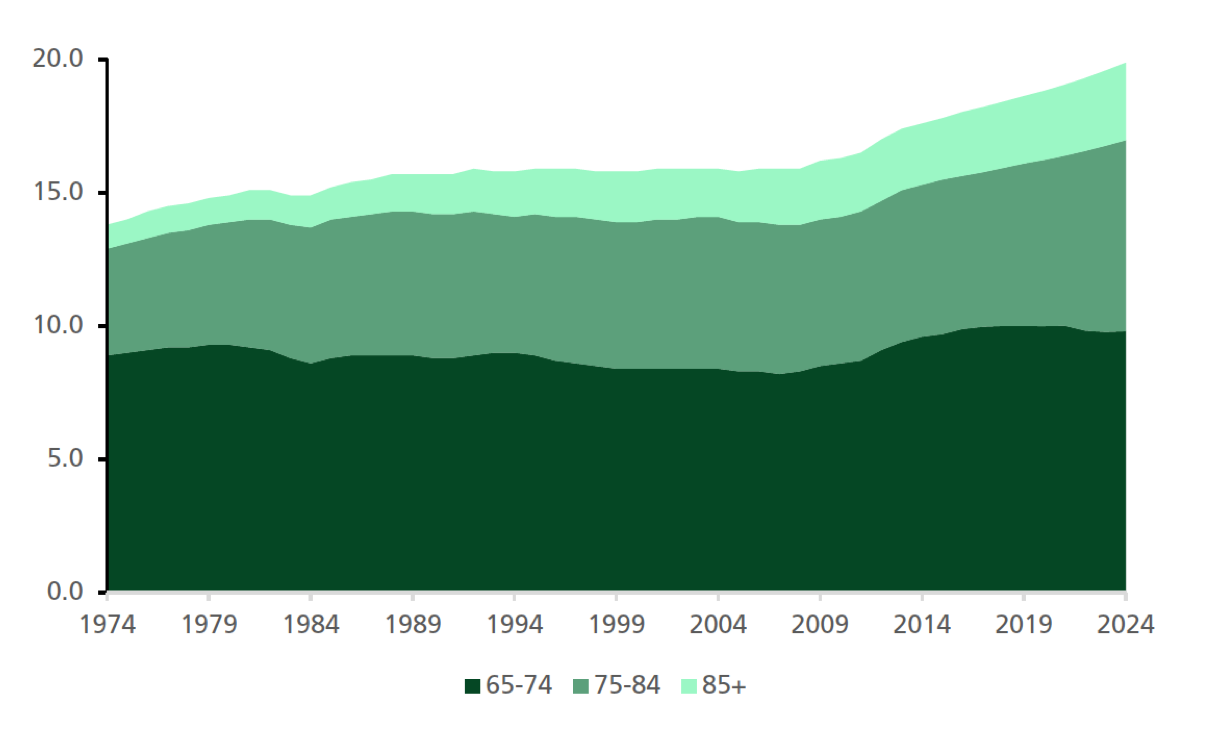
Genuine and projected (from 2015) percentage of the UK population at 65–74, 75–84, and 85+ since 1974. Sources: Office of National Statistics — ageing of the UK population, and 2014 based population projections.
The number of people aged 65+ is expected to rise by over 40% in the next 17 years. A third of them currently live alone. Although increase in living standards and modern medicine has increased life expectancy significantly, quality near the end of life is still questionable. In 2017, more than 60% of all people over the age of 65 had at least two limiting longstanding illness. This increased number of older adults and increasing number of comorbidities translates to a whooping 155% increase in net social service expenditure by 2035, with 63% of them paying for this care directly.
Disruption in healthcare
Disruption in healthcare sounds like an oxymoron — historically healthcare has been a beast slow at best and often resistant to change. But disruption has been brewing — now accelerated with the announcement of tech giants getting into the game. This wave has not left the UK untouched — with companies like Google DeepMind, Babylon health, BenevolentAI, and others increasingly using AI in healthcare.
Social care in the UK fulfils all of the criteria for an industry ripe for disruption. Market power is consolidated by public pay where local authority commissioners exercise monopsony power over the purchase of services. The industry is using outdated technology — a majority of home care visit notes are still in paper, and if there are electronic platforms used, data entry is cumbersome. There are almost no companies applying AI to social care data, (but that is changing as I write this). Care worker scheduling & tracking, patient monitoring and remote communication is still limited to landlines or text messaging, and data integration happens by fax (personal communication). Business practice hasn’t changed for decades, partially leading to decreased quality of social care — 28% of care services are deemed inadequate or requiring improvement by the CQC. Among nursing homes, 37% require improvement and 4% are inadequate. Number of complaints received about independent providers has increased by 19% since 2015. Either services are worsening or companies that are struggling to maintain their high standards are giving in — underlying profitability of UK’s three major residential care providers tanked in 2013 (LaingBuisson research (2013), see graph below. Finally, the research backs the fact that this disruption is long overdue.
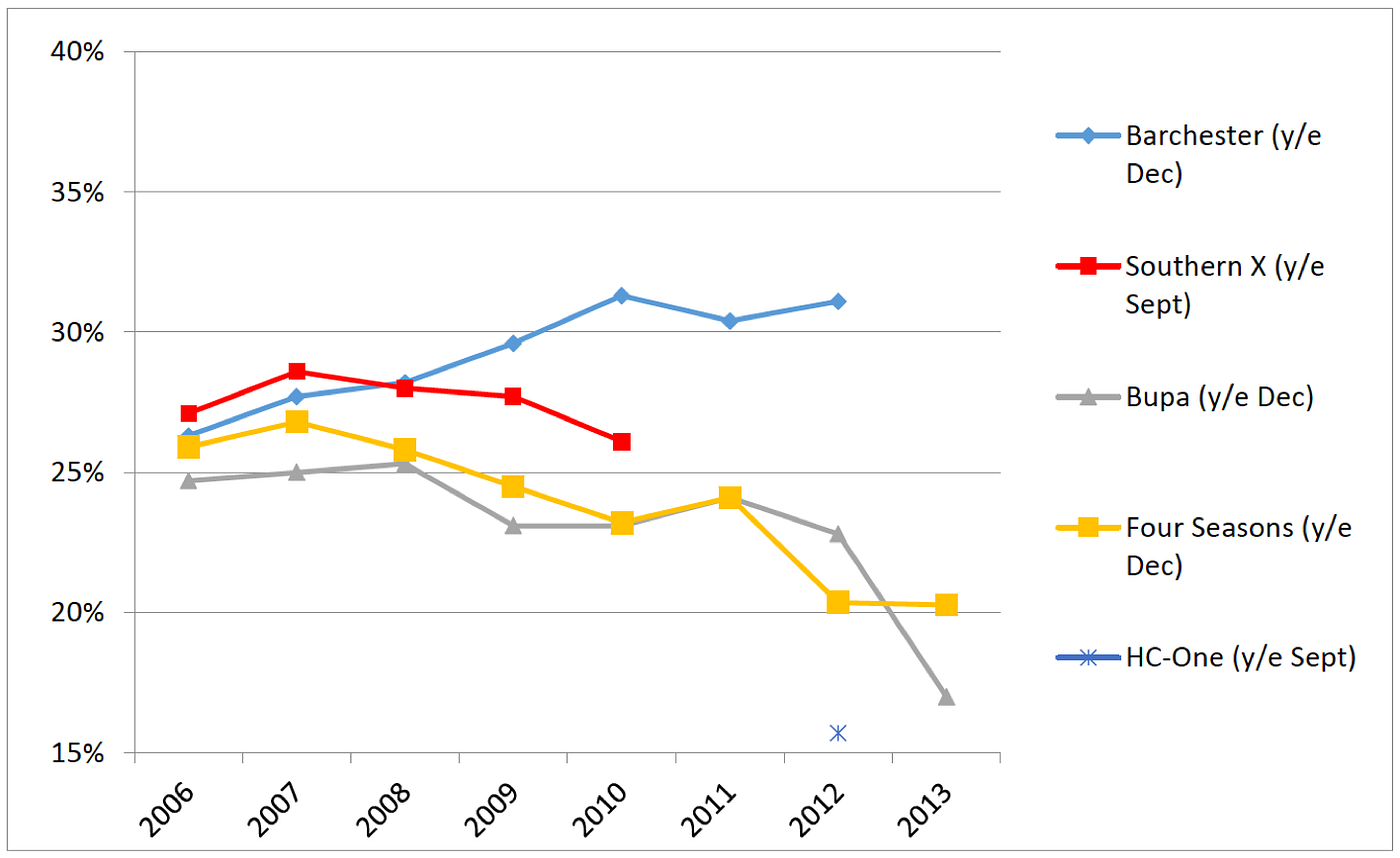
Underlying profitability of major providers of care homes for older people — EBITDAR (Earnings Before Interest, Tax, Depreciation, Amortisation of goodwill and Rent on leased premises) as a percentage of revenue. Source LaingBuisson research, statutory accounts (2013).
There are certainly challenges — the market is fragmented, with four leading providers controlling 16% of the care home market and 14% of the home care market nationally. Public funding, as discussed earlier, is dwindling and as a result there is endemic cross subsidies from private to public payers. The market is also highly polarised between rich and poor neighbourhoods (popularly known as the post code lottery!). The care sector, just like healthcare, is highly regulated but unlike healthcare does not lend itself well to economies of scale.
In spite of this, I expect an explosion of social care tech companies in the next 3–5 years. Some that are beginning to pave this way, like Cera and OnCare have seen what is coming. Existing care companies either will take this seriously and adopt technologies to keep themselves ahead of the game or will be replaced by those who do.
If you enjoyed this post, please clap / love / like and share. If you’re excited about social care and AI, ping me on Twitter @xenoach.
Originally published on Medium.